
[Authors: Meet Patel, Final Year Student, Damodaram Sanjivayya National Law University (DSNLU), Visakhapatnam]
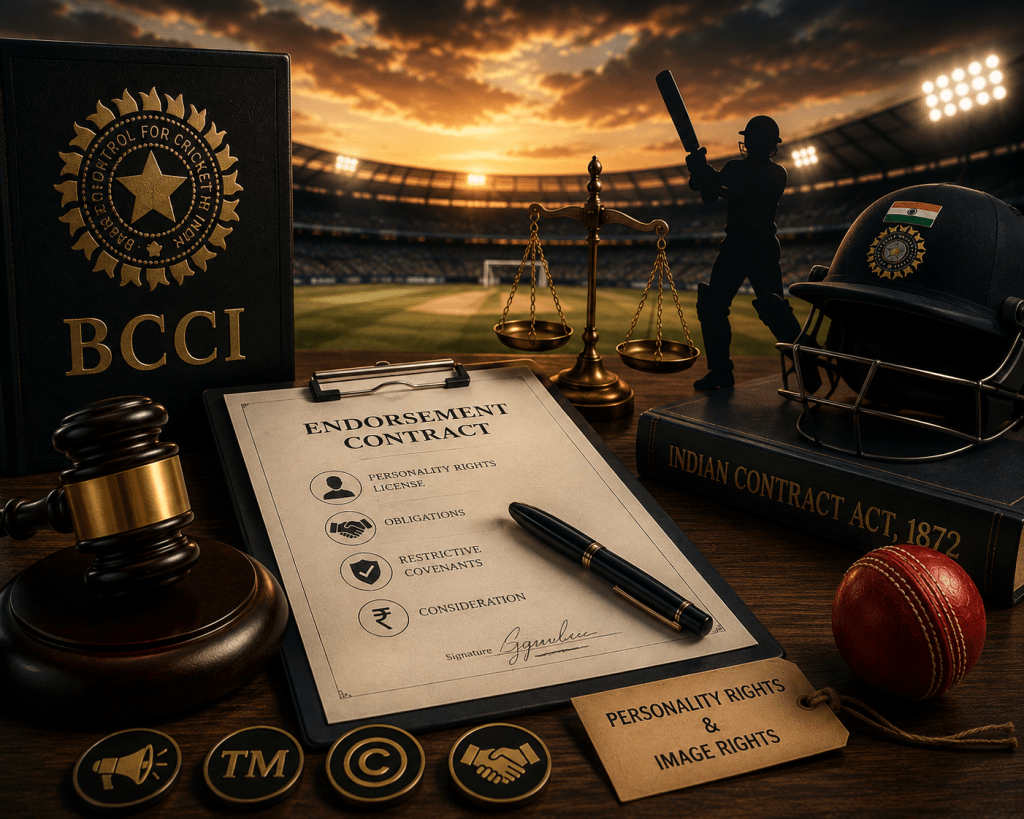
Indian cricket has evolved into a multi-billion-dollar commercial ecosystem where endorsement contracts function simultaneously as intellectual property licences, marketing instruments, and contractual risk allocators. This article critically examines three core dimensions of endorsement agreements in Indian cricket: (i) the enforceability and proportionality of restrictive covenants under Section 27 of the Indian Contract Act, 1872; (ii) the licensing of personality rights and image rights in the absence of a dedicated statutory framework; and (iii) the structural conflicts of interest embedded in the BCCI’s dual role as both regulator and commercial stakeholder. Drawing on BCCI central contract terms, IPL Franchise Agreements, and judicial precedents including Percept D’Mark v. Zaheer Khan and Zee Telefilms v. Union of India, this paper argues that the current framework inadequately protects player autonomy, lacks transparency in IP licensing terms, and requires both legislative and regulatory reform to align with international standards of sports contracting.
I. Introduction
Cricket in India is not merely a sport; it is a cultural institution that produces some of the most commercially valuable personal brands in the world. Virat Kohli is consistently ranked among the highest-earning sports personalities globally, with endorsement revenues that far exceed his playing income. Yet the legal architecture governing how these commercial relationships are formed, managed, and enforced remains remarkably underdeveloped by international standards.
An endorsement contract in the cricket context is, at its core, a licence for the commercial exploitation of a player’s personality their face, name, voice, signature, playing style, and public persona. Layered on top of this are restrictive clauses governing competing brand endorsements, social media conduct, and public behaviour. These contracts must navigate the Indian Contract Act, 1872, the Trademarks Act, 1999, the Copyright Act, 1957, and the rapidly evolving jurisprudence around personality rights.
The problem is compounded by the dominant position of the Board of Control for Cricket in India (BCCI), which simultaneously acts as India’s cricket regulator, IPL organiser, and employer of centrally contracted players. The Lodha Committee reforms of 2016, accepted by the Supreme Court in BCCI v. Cricket Association of Bihar, addressed administrative governance but did little to reform the contractual framework governing player-commercial relationships. This article analyses restrictive covenants (Part III), IP licensing (Part IV), the BCCI’s structural conflict of interest (Part V), comparative perspectives (Part VI), and concludes with reform proposals (Part VII).
II. The Contractual Architecture of Endorsement Agreements in Indian Cricket
A professional cricketer operates under a layered system of obligations. At the apex sits the BCCI Central Contract, which governs the player’s relationship with the national team. Below this, franchise agreements with IPL teams add a second tier of obligations. Alongside both runs the player’s individual endorsement portfolio, which must be carefully structured to avoid conflict with BCCI and franchise obligations.
The BCCI Central Contract for 2025–26 divides players into three grades A, B, and C[AB1] with annual retainerships of ₹5 crore, ₹3 crore, and ₹1 crore respectively. The contract imposes significant commercial restrictions, including prohibitions on endorsements that conflict with official BCCI sponsors. The commercial framework may prevent centrally contracted players from entering endorsements agreements that conflict with the BCCI’s official sponsor categories during the subsistence of the central contract thereby limiting commercial opportunities in those sectors.
This creates an immediate structural tension. A player’s status as an independent commercial entity entitles them, in principle, to freely commercialise their personality rights However, the BCCI Central Contract imposes contractual restrictions on the exercise of those rights where their commercial exploitation would conflict with BCCI’s sponsorship and commercial arrangements. Rather than constituting a compulsory license in the statutory sense, the arrangement is more accurately characterised as a contractually imposed limitations on the player’s ability to exploit certain commercial attributes, arising from the allocations of commercial rights band obligations under the contract.
The IPL Franchise Agreement [AB2] introduces a parallel layer. Under the standard franchise structure, players must take part in commercial and promotional activities jersey appearances, social media posts, fan interactions without separate individual compensation. The BCCI’s Brand and Content Protection Guidelines provide that players’ images captured during IPL matches may be used for promotional purposes by the BCCI, franchises, and official partners without individual player consent being required for each use. The player has no contractual veto during the tournament window.
III. Restrictive Covenants: Section 27 and the Restraint of Trade Doctrine
Section 27 of the Indian Contract Act, 1872 provides that every agreement by which any person is restrained from exercising a lawful profession, trade, or business of any kind is to that extent void. Unlike English law, which developed a reasonableness doctrine, Indian courts have historically taken a stricter view, treating Section 27 as an almost absolute rule against post-contractual restraint.
The leading authority remains Percept D’Mark (India) Pvt. Ltd. v. Zaheer Khan, in which the Supreme Court refused to enforce a post-termination exclusivity clause in an agent’s contract with cricketer Zaheer Khan. The Court held that the clause restrained Khan from exercising his lawful profession of endorsing products through an agent of his choosing and rejected the argument that the clause was a reasonable commercial protection for the agency’s investment. This case is still the central precedent for any analysis of restrictive covenants in Indian sports contracts. However, Percept D’Mark should not be understood as a rendering every restrictive convenient in a sports endorsement agreements void. The judgement principally addresses restraints that survive the termination of the contractual relationship. A distinction must therefore be drawn between negative covenants regulating a player’s conduct during the currency of the latter ordinarily attract the prohibition contained in Section 27.
Despite this clear precedent, the enforceability of restrictive covenants in Indian Cricket endorsement agreements depends upon whether they operate during the subsistence of the contract or continue after its termination or expiry. Indian courts have recognised that in-term exclusivity obligations ordinarily regulate the manner in which contractual obligations are performed and are therefore distinguishable from restraints on trade. Accordingly, category exclusivity provisions requiring a player to endorse only one brand within a particular product segment during the contractual period may be commercially justified and are generally capable of enforcement. By contrast, post termination non- complete clause that prohibits a player from endorsing competing brands for. Specified period after the agreement ends are more likely to attract the prohibition contained in Section 27, as they restrict the player’s future professional opportunities after the contractual relationship has ceased. Morality clauses occupy a distinct position, since they do not directly restrain trade but instead regulate the circumstances in which a brand may terminate the agreement.
Morality clauses present a different legal concern. Unlike exclusivity or non-compete provisions, they do not, in themselves, restrain a player’s ability to carry on a profession. Their enforceability instead depends upon the breadth of the discretion they confer upon the contracting brand and the consequences flowing from termination. Where expressions such as “disreputable conduct” or “conduct detrimental to the brand” remain undefined, the brand may acquire an excessively broad unilateral power to terminate the agreement and, in some cases, seek to enforce consequential post-termination restrictions. Such provisions may invite scrutiny under Section 23 of the Indian Contract Act as being unconscionable or contrary to public policy. The Supreme Court’s reasoning in Central Inland Water Transport Corporation Ltd. V. Brojo Nath Ganguly indicates that contractual terms conferring arbitrary and one-sided powers, particularly in standard-form agreements characterised by unequal bargaining power, may be rendered unenforceable.
IV. Intellectual Property Licensing in Endorsement Contracts
The IP dimension of endorsement agreements is their most legally complex feature. In the absence of a dedicated publicity rights statute, player image and personality rights are protected through a patchwork of trademark law, copyright law, and constitutional privacy jurisprudence. The Delhi High Court has begun to consolidate this into a coherent framework, most prominently in Anil Kapoor v. Simply Life India & Ors. and Sunil Gavaskar v. Cricket Tak & Ors., both of which recognised a public figure’s persona as a legally protectable interest against unauthorised commercial exploitation.
Within an endorsement agreement, the IP licence grants the brand a defined right to use specified aspects of the player’s personality name, likeness, signature, and sometimes voice for approved commercial purposes over the contract term. The challenge lies in the gap between commercial reality and contractual documentation. Many agreements are drafted with ambiguous scope clauses that fail to define what ‘likeness’ encompasses in the digital age.
Does the licence extend to AI-generated avatars of the player? Does it permit use of the player’s image in sponsored posts created by third-party accounts? Does it allow a player’s voice, captured in an interview, to be used in an audio advertisement? These are not hypothetical questions they arise routinely in digital-first endorsement campaigns. The Delhi High Court’s interim orders in Amitabh Bachchan v. Rajat Nagi & Ors. and related personality rights cases demonstrate that courts will intervene against AI-generated misuse of a celebrity’s identity. However, an endorsement contract that licences the player’s image without expressly excluding AI-generated replicas may inadvertently authorise precisely the kind of synthetic media these courts have found objectionable. Clearer drafting standards are required, including contractual provisions mandating express opt-in consent for AI-generated or synthetic media, restriction on the use of player’s image, voice cloning and digital replicas, prior approval rights for AI- generated commercial content, restrictions on sub licensing such rights, deletion obligation upon termination or expiry of the agreement, clearly defined territorial and temporal limits on AI-related licences, and post termination takedown obligation for unauthorised AI-generated content.
V. Conflict of Interest: The BCCI’s Dual Role
The most structurally significant issue in Indian cricket’s endorsement landscape lies not in exclusivity clauses themselves but in the BCCIS’s overlapping institutional roles.. The BCCI simultaneously functions as the regulator of Indian Cricket, organiser of the Indian Premier League, contracting authority for centrally contracted players, and beneficiary of a commercial ecosystem that generated over $6 billion through the sale of media rights for the 2023–2028 cycle. These overlapping roles place the Board in the unique position of regulating commercial conduct while also possessing a direct financial interest in the commercial arrangements it seeks to protect.
The conflict becomes more apparent when viewed though the BCCI’s multiple institutional roles. Assume that a centrally contracted player receives an endorsement offer from a financial services company that competes direct Ely with an official BCCI sponsor during the currency of the central contract and the applicable commercial rights framework, the player may be prohibited from accepting the competing endorsement while representing the national team. Such in-term category exclusivity is not inherently objectionable; it serves recognised commercial objectives, including protecting sponsor value, preventing ambush marketing, and preserving the integrity of centrally negotiated sponsorship arrangements. The legal concern therefore does not arise merely because exclusivity exists. Rather, it arises because the BCCI determines the scope of those commercial restrictions, derives substantial financial benefit from the Sponsorship arrangements they protect, and exercises significantly regulatory authority over the players to whom those restrictions apply. Consequently, where disputes arise regarding the interpretation, application, or alleged breach of such restrictions, questions emerge as to whether a body possessing a direct commercials interest should simultaneously control the regulatory framework governing those disputes.
The goverance concern is further compounded by the manner in which commercial disputes are resolved within Indian Cricket. Since the BCCI prescribes the contractual framework governing centrally contracted players and exercise disciplinary and regulatory authority over participation in domestic and international cricket, it retains considerable influence over the institutional process through which disputes concerning commercial restrictions may initially be addressed. Even where disputes ultimately proceed to arbitration or the courts, the concentration of regulatory, commercial, and supervisory functions within a single institution creates an appearance of institutional bias that is inconsistent with Morden principles of sports governance. International best practices increasingly favour the separation of commercial decision-making from disputes resolution in order top preserve both actual and perceived independence.
Although this institutional arrangement survived constitutional scrutiny in Zee Telefilms Ltd. v. Union of India, where the Supreme Court held that the BCCI is not ‘State’ within the meaning of Article 12 of the Constitution, the decision did not immune the Board from judicial a review in every circumstance. Courts have subsequently recognised that writ jurisdiction under Article 226 may be invoked where the BCCI performs public or regulatory functions. Consequently, while disputes arising purely from endorsement contracts ordinarily remain matter of private law, decision concerning the interpretation and enforcement of commercial restrictions imposed by the BCCI may, in appropriate cases, attract judicial scrutiny where questions pf procedural fairness, arbitrariness, or conflict of interest arise. This instructional overlap underscores the need for a more transparent and independent mechanism for resolving commercial disputes involving centrally contracted players
VI. Comparative Perspectives
A comparison with other cricket-playing jurisdictions reveals the gap between Indian practice and international standards. In England, the ECB Player Regulations Establish a clear distinction between individual and collective commercial rights while providing structured mechanism for the resolution of commercial disputes. In Australia, the ACA’s Memorandum of Understanding between Cricket Australia and the Australian Cricketer Association (ACA) facilitates collective bargaining and regulates the commercial exploitation of players image right, including provision relating to emerging technologies. Similarly, the NBA Collective Bargaining Agreement contains detailed provisions governing the commercial use of player name, images, likenesses and digital content. While these models differ in their institutional structure, they share common features, including clear allocation of individual and group image rights, defined category exclusivity, regulations of AI and digital uses, collective bargaining mechanism, player approval rights, and structured dispute resolution processes. Although direct transplantation of these models to India may not be appropriate, these principles provide a useful benchmark for reform.
VII. Reform Proposals and Conclusion
The foregoing analysis identifies three fundamental problems: (i) overly broad restrictive covenants of doubtful enforceability; (ii) inadequate IP licensing standards for the digital and AI age; and (iii) a structural conflict of interest in the BCCI’s dual role. Each calls for a specific remedial response.
First, the BCCI should promulgate a Standard Endorsement Contract Guideline setting minimum standards for IP licensing scope, proportionality in restrictive covenant duration, and definitional precision in morality clauses. This could be implemented through BCCI’s existing regulatory authority without legislative intervention.
Second, India’s personality rights reform whether through amendment of the Copyright Act’s performer rights provisions (Section 38) or through the expected Digital India Bill should expressly address the endorsement context. A requirement of express written consent for AI- generated commercials uses of a player’s identify, rather than reliance on broad omnibus contractual clauses, would provide greater legal certainty and strengthen the protection of personality rights.
Before proposing institutional reforms, it is necessary to recognise the existing dispute-resolution framework governing centrally contracted cricketers. Commercial disputes arising under BCCI player contracts are ordinarily resolved in accordance with the dispute-resolution clause contained in the relevant contract, which typically culminates in arbitration under the Arbitration and Conciliation Act,1996. However, question concerning the interpretation and application of commercial restrictions often arise within a regulatory framework designed and administrated by the BCCI itself. Consequently, although arbitration provides an external forum for adjudication, the Board continues to exercise considerable influence over the contractual and regulatory architecture from which such disputes originate. This concentration of regulatory and commercial functions goes rise to legitimate concerns regarding institutional independence and perceived fairness.
Third, to strengthen institutional independence, the BCCI should establish an independent Endorsement Review Committee comprising legal experts, player representatives and independent members with expertise in sports governance. The Committee should function as the first instance forum for disputes relating to commercial restrictions imposed under central contracts. Appeals from its decision should lie to an independent arbitration tribunal in accordance with the arbitration agreement contained in the relevant BCCI contract, thereby preserving party autonomy while ensuring that disputes are initially examined by a body free from direct commercial interests.
Endorsement contracts in Indian cricket stand at the intersection of commercial law, intellectual property, and sports governance. The current legal framework built around a statute from 1872, an IP regime that did not expect digital media, and a governance structure that conflates regulation with commercial interest has not kept pace with the sophistication of the agreements it is asked to regulate. The reforms proposed here offer a practical and achievable starting point for bringing that balance closer to what both fairness and efficiency require.
About the Author
Meet Patel is a final year law student at the Damodaram Sanjivayya National Law University (DSNLU), Visakhapatnam. An active sportsperson, he has taken part in football, cricket, volleyball, and tennis, giving him a practitioner’s understanding of the competitive and commercial pressures professional athletes navigate. His research interests sit at the intersection of Artificial Intelligence, Technology Law, Contract Law, Arbitration, and Intellectual Property Rights, with a particular focus on how emerging technologies and standard-form commercial contracts affect the rights of athletes and creators in the Indian context. The views expressed in this paper are those of the author alone.
*DISCLAIMER- The opinions and views expressed in this article are that of the Author(s) and not of SLRI- the expressed opinions do not, in any way whatsoever, reflect the views of any third party, including any institution/organisation that the Author(s) is/are currently associated to or was/were associated to in the past. Furthermore, the expressions are solely for informational and educational purposes, and must not be deemed to constitute any kind of advice. The hyperlinks in this blog might take you to webpages operated by third parties- SLRI does not guarantee or endorse the accuracy or reliability of any information, data, opinions, advice, statements, etc. on these webpages.
PREFERRED CITATION: Meet Patel, “Endorsement Contracts in Indian Cricket: A Critical Analysis of Restrictive Clauses,IP Licensing, and BCCI’s Dual Role” , published on 12 August, 2026.


Leave a comment