
[Author: Shauryaveer Chaudhry, Third Year Student at the National Law School of India University]
This article argues that executive decisions recognising National Sports Federations involve polycentric allocations of regulatory authority that warrant only restrained judicial scrutiny. It contends that Wednesbury reasonableness and not proportionality remains the doctrinally appropriate standard of review, even under the specialised framework introduced by the National Sports Governance Act, 2025.
Introduction
Recently, the Delhi High Court had taken up a challenge by the All India Pickleball Association (“AIPA”) against the Ministry of Youth and Sports (“MYAS”)’s declaration of Indian Pickleball Association (“IPA”) as the National Sports Federation (“NSF”) for the sport of pickleball. This notification was made under the National Sports Development Code of India, 2011 (“Sports Code”). The Court, inter alia, held that the MYAS is presumed to have domain expertise over matters of sports policy. The nature of granting recognition is not a permanent, one-time event, and rather is meant to be periodically revisited, and can be withdrawn if the need arises. The Court ultimately agreed with the submission that discretion in granting relaxation under the Sports Code is a policy decision and refused to interfere with the same in a proceeding under Article 226 of the Constitution.
The central question this blog piece tries to answer is to what extent should judicial review be permitted into a notification of the executive recognising a body as an NSF, and how this is further complicated by the National Sports Governance Act 2025 (“NSGA”).
This blog builds on existing administrative law jurisprudence on the proportionality test and the Wednesbury unreasonableness test as used in the Indian context by focusing on one specific form of executive policy making. NSF recognition has been chosen as the central medium of analysis in this blog due to its position as a site of constitutional tension.
This piece does this by firstly exploring the legal character of NSFs to establish that its recognition is exclusionary and power-allocative, secondly by mapping the standards of review available to courts in the given context, lastly byexamining how the NSGA may impact the existing analysis that I have conducted. The conclusion I attempt to reach is that a heightened proportionality review is not warranted in the present case.
The Legal Nature of NSF Recognition
The Executive, in a welfare state like India, has an interest in promoting sports due to its benefits in daily health as well as spreading national pride. Sports fall into the II list according to Entry 33 in the 7th Schedule.
The recognition of an NSF confers regulatory authority over a sporting discipline in India. The recognised body is empowered to frame selection criteria and represent India on the international stage. The body functions as the sole interlocutor between athletes and the State. Furthermore, NSF recognition operates as a gateway to public funding and access to government infrastructure. Cumulatively, recognition adds institutional legitimacy to such a body. Denial of this recognition produces consequences such as exclusion of public benefits and regulatory marginalisation.
Clause 3.10 of the Sports Code clearly states that there will be only one NSF for each sport at the national level. In Rajasthan Equestrian Association v. Union of India (paragraph 11), the court held that recognition of an NSF is a policy decision and the relaxation of the code while granting such recognition is possible where it is deemed to be necessary and expedient for the promotion of sports or sportspersons, or for resolving specific challenges faced by the NSFs.
Mapping the Standards of Review
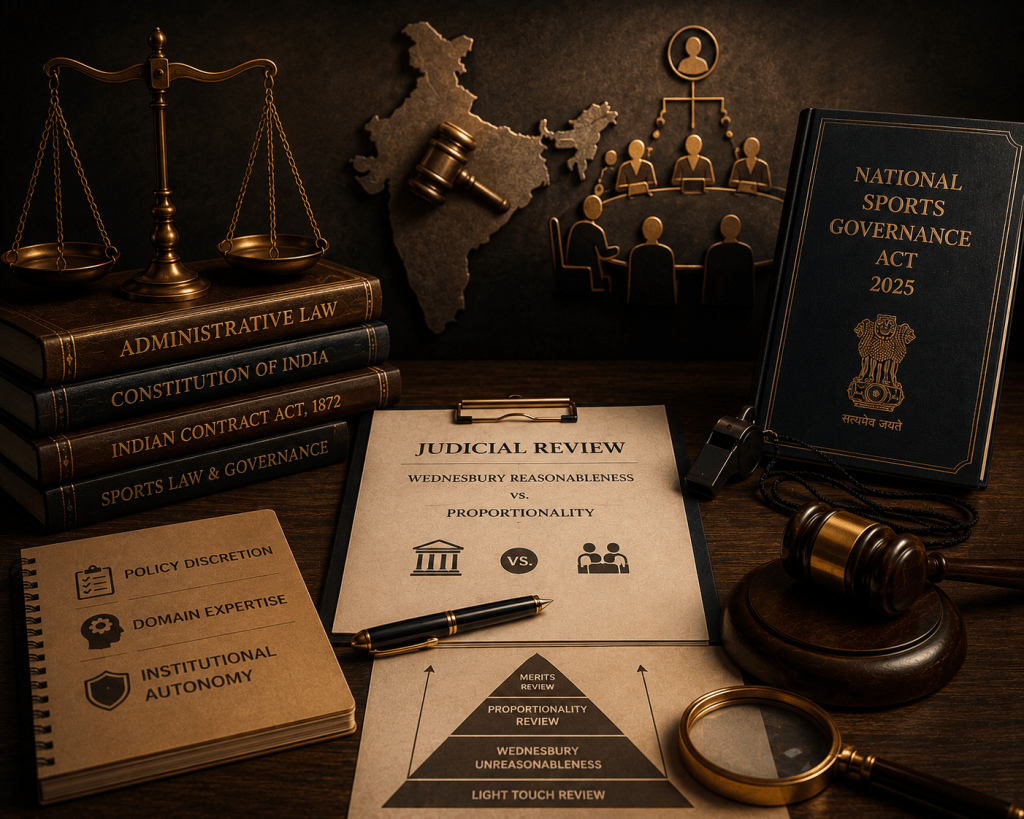
Judicial review of administrative decisions does not make use of a single, uniform standard. Rather, Indian public law recognises a spectrum of review intensity. At one end of the spectrum lies the light touch review traditionally associated with policy decisions and involves an extremely restrained and deferential approach by courts. At the other end lies the merits review, where courts effectively substitute their judgement for that of the Executive. Between these poles lie the Wednesbury unreasonableness review as well as the proportionality review.
The judiciary initially had taken a keen liking to the Wednesbury standard of review. This standard first emerged in the landmark Associated Provincial Picture Houses Ltd. v. Wednesbury Corporation case. It requires courts to examine whether the Executive in making that decision:
- Took into account factors that ought not to have been taken into account or;
- It failed to take into account factors that ought to have been taken into account or;
- The decision was so unreasonable that no reasonable authority would ever consider imposing it.
The scope of judicial review, therefore, under this standard is limited since the wisdom of the Executive in policy decisions remains supreme.
Proportionality review, on the other hand, requires judges to analyse the decision from the perspective of those who stand to derive the greatest benefit as well as with the most to lose. Courts are required to ask whether there is a legitimate aim being achieved with the chosen policy, the means chosen to achieve such an aim is suitable, necessary (least restrictive) and balanced. It is a more intrusive standard of review with a four-staged inquiry conducted by the Court.
Om Kumar v. Union of India provided doctrinal clarity on when each of the standards of review should be employed. Proportionality is to be used when the question is of equality whereas Wednesbury unreasonableness is meant for situations warranting the test of arbitrariness in administrative decisions. This distinction however, has been collapsed and Chandrachud demonstrates to show that while proportionality is used as the lingua franca, the real standard of review being employed is that of Wednesbury unreasonableness. Indian courts rhetorically invoke proportionality, while applying a “shockingly disproportionate” threshold. This makes the proportionality standard of review functionally indistinguishable from the Wednesbury unreasonableness threshold. Indian jurisprudence in itself is confused when to apply the proportionality test and when not to. Further, even then the test is utilised, the 4-stage enquiry is not undertaken with the depth that is it meant to be.
Now that the doctrinal position in Indian jurisprudence has been established, the central question in respect to NSF recognition can be explored. NSF recognition involves the classification and allocation of public authority. Proportionality would break down in the current context because there are no judicially manageable least restrictive alternatives and recognition of one federation as the NSF necessarily would exclude the other. The balancing prong of the proportionality review would require courts to assess which body would promote the sport better. Such a review would collapse the proportionality review into a merits review standard. This would be violative of the concept of separation of power, since as was held in A.K. Gopalan v. State of Madras that it is not up to the courts to challenge the wisdom of a policy decision of the Executive.
The author’s argument is not that Wednesbury is appropriate because courts already use it in practice, but that it is the correct doctrinal standard for reviewing NSF recognition decisions. This is because NSF recognition is a polycentric, exclusionary policy decision involving the allocation of regulatory monopoly and public authority, for which there is no judicially manageable least-restrictive alternative. Applying full proportionality review would therefore collapse into impermissible merits review, violating separation-of-powers concerns. Wednesbury reasonableness, by contrast, preserves legality review without requiring courts to second-guess executive assessments of sporting governance.
A closer reading of the Delhi High Court’s reasoning makes clear that the Court’s intervention was confined to a classic Wednesbury inquiry. The Court examined whether the Ministry acted within the scope of its authority under the Sports Code, particularly its power to relax Code requirements, and whether the decision was procedurally and rationally defensible. The Court did not undertake any assessment of the relative institutional competence, representativeness, or sporting credentials of AIPA and IPA, nor did it ask whether recognising one body over the other was necessary or optimally balanced. Such questions were treated as lying squarely within Executive discretion. The court limited review to the relevance of considerations and non-arbitrariness while eschewing comparative evaluation and outcome-based balancing. Thus, the Court adopted a form of reasonableness review that aligns with Wednesbury rather than proportionality. The judgment exemplifies restrained judicial supervision that polices the boundaries of executive power without collapsing into merits review.
Provisions in the Sports Code inherent to good governance and the principes of natural justice such as those related to holding of elections, transparency of accounts, age or tenure restrictions, are necessarily mandatory and uniformly binding on all associations. However, the Court held that remaining provisions of the Code must be applied in a manner by the MYAS in a manner that is sensitive to the context of the sport, and with the objective of the development of the sport.
Justice Datta further distinguished between legacy sports and nascent sports. Legacy sports such as cricket have executive institutions that have existed for a long period of time, and have institutions and frameworks that have deep district-level penetration. The Sports Code, as the Court notes, was framed with these legacy sports in mind. Nascent sports like pickleball have emerged recently, and cannot be treated at par with these established sports. The Sports Code, which is not statutory code cannot be construed rigidly, and by its very nature cannot be applied mechanically. It must adhere to the principle of reasonableness and avoid absurd counter-productive outcomes. Unless these principles are violated, the Court would not interfere with the highly policy driven nature of the Code.
NSGA 2025 and the Future of Review
The NSGA marks a shift in the architecture of Indian sports governance architecture in two significant ways. Firstly, it statutorily enforces governance norms that were earlier enforced through Executive policy. Secondly, and more importantly for the current inquiry, it establishes the National Sports Tribunal (“NST”) as a specialised adjudicatory body empowered to hear disputes arising under the Act.
The creation of the NST reflects a broader administrative-law trend towards specialised adjudication. Tribunals are justified on the basis that domain expertise enables more context-based decision making.
Courts may show greater deference to specialised tribunals on matters within their technical competence. However, such deference does not displace constitutional review altogether. The presence of a specialised tribunal alters who conducts first-instance review, but it does not fundamentally change what kind of review is appropriate for NSF recognition and classification decisions. Even under the NSGA, decisions concerning recognition, renewal, exemptions, and classification of National Sports Bodies remain polycentric and policy-laden. They involve allocation of public authority and regulatory monopolies. The only change is the process and the implications of recognition has been clearly laid down now in the statue and the function of the NSGs remains to be largely unaffected. As such, the logic articulated earlier in this blog continues to apply to the extent that full proportionality review remains doctrinally inappropriate. Accordingly, Wednesbury unreasonableness potentially in an enhanced form should remain the baseline standard, both before the Tribunal and on subsequent judicial review. The Tribunal’s expertise may justify greater tolerance of executive or regulatory judgment but not abdication of legality review.
Under section 8 of the NSGA, the National Sports Board established under section 5 of the Act has the power to recognise a sports organisation as a National Sports Body. The National Sports Boards Rules 2026 contemplates situations competing federations or international bodies exist and requires the boards to decide appropriate affiliation, while recording reasons for the same.
*DISCLAIMER- The opinions and views expressed in this article are that of the Author(s) and not of SLRI- the expressed opinions do not, in any way whatsoever, reflect the views of any third party, including any institution/organisation that the Author(s) is/are currently associated to or was/were associated to in the past. Furthermore, the expressions are solely for informational and educational purposes, and must not be deemed to constitute any kind of advice. The hyperlinks in this blog might take you to webpages operated by third parties- SLRI does not guarantee or endorse the accuracy or reliability of any information, data, opinions, advice, statements, etc. on these webpages.
PREFERRED CITATION: Shauryaveer Chaudhry, “Federations, Fairness and the Frontiers of Review” , Sports Law Review India, published on 23 August, 2026.


Leave a Reply