
[Authors: Tarun, Faculty & Member, GNLU Centre for Sports and Entertainment Law; Anamika Shukla, Faculty & Member, GNLU Centre for Sports and Entertainment Law & Dr. Niyati Pandey, Faculty & Head, GNLU Centre for Sports and Entertainment Law]
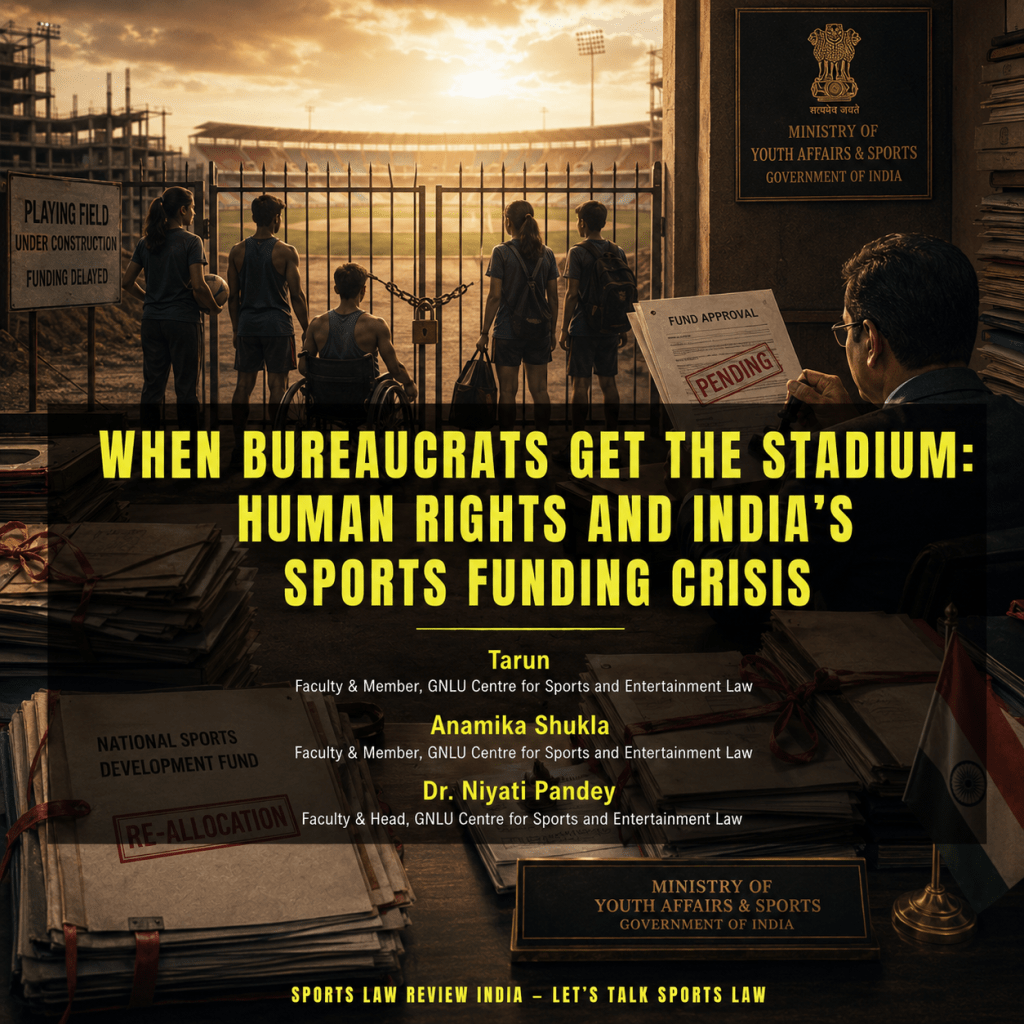
The recent report by The Indian Express on the misutilisation of funds under the National Sports Development Fund (NSDF) to develop sports facilities for senior government officials, raises critical questions on constitutional accountability of the State. It subsumes peripheral concerns around human rights implications for athletes’ right to access of quality infrastructure, and consequently, to their very dignity and livelihood.
The NSDF was introduced in 1998 to generate funds towards developing sports infrastructure in India for athletes. The report spills open the diversion of these funds towards sports facilities at exclusive upscale residential colonies of bureaucrats. The issue cascades through financial impropriety to administrative accountability and pivots on constitutional guarantee of equality by enquiring India’s stand under the international human rights law.
India ratified the International Covenant on Economic, Social and Cultural Rights (ICESCR) in the year 1979. Albeit not an overt right, sporting ecosystem interacts with several recognised rights including right to health and the broader commitment to human development and equality. It is imperative to place reliance upon the principle of “maximum available resources” under Article 2 of ICESCR. The human rights culling out of it obligates the State to ensure availability of resources and their justiciable utilisation. Digressing resources for facilitating amenities for bureaucrats under the veil of building world-class sports facilities for athletes, is a direct contravention of these rights.
The International Olympic Committee’s (IOC) Charter, under the 4th Fundamental Principle of Olympism states that sports is a human right. It also mandates the signatories to provide access to individuals to practice sport, without any kind of discrimination. Athletes in India, especially para-athletes and those belonging to disadvantaged socio-economic groups, depend on government funded facilities. The repercussions of diversion of NSDF funded facilities and resources directly thumps their accessibility to world-class infrastructure that impacts performance at global sports events, and as a natural corollary their right to livelihood.
The controversy steps beyond international human rights instruments and attacks the spirit of the Indian Constitution. Through Article 14 and 21, the framers of Indian Constitutions have acknowledged various internationally recognised human rights like right to equality and protection of life and personal liberty. The Supreme Court of India has continually developed an all-encompassing view of Article 14 which guarantees equality before the law and equal protection of the laws. Judicial precedents have enforced Article 14 to outlaw arbitrary administrative action. In E.P. Royappa v State of Tamil Nadu (1974) the Supreme Court observed that “equality is anti-thetic to arbitrariness”. While discussing dissimilar treatment, in its 1984 judgment of A.L. Kalra v P & E Corporation of India Limited the Supreme court observed that, “An action per se arbitrary itself denies equal protection of law.” Departure from the true purpose of NSDF directly raises concerns about arbitrariness under Article 14.
The Constitution does not recognise sporting success as a fundamental right. Courts have, however, protected dignity, health and conditions necessary for individuals by enforcing Article 21 in number of its judgments. Thus, wherever State mechanisms facilitate athlete development outside the permitted statutory guardrails, questions of fairness and arbitrariness automatically arises. In the landmark judgment of Olga Tellis v Bombay Municipal Corporation (1986), the Supreme Court of India has recognised Right to Livelihood as a fundamental right under Article 21. Thus, absence of access or unequal access is not only detrimental to athlete’s growth and a hinderance to their livelihood opportunities, it is also a clean violation of the constitutional mandate.
The controversial report has brought the deep-rooted fractures in the Indian sporting governance model to the spotlight. The State needs to recalibrate its priorities and rebuild public trust. The only way forward is by ensuring transparency in all future NSDF allocations. There is a cogent need to have periodic public disclosures and independent audits. Involving athletes, as mandated under the new National Sports Governance Act 2025, in funding and oversight committees should be institutionalised for maximum compliance and benefit. Moreover, all allocations should be subjected to a rights-based impact assessment in alignment with Articles 14 and 21 of the Constitution and India’s obligations under the ICESCR.
*DISCLAIMER- The opinions and views expressed in this article are that of the Author(s) and not of SLRI- the expressed opinions do not, in any way whatsoever, reflect the views of any third party, including any institution/organisation that the Author(s) is/are currently associated to or was/were associated to in the past. Furthermore, the expressions are solely for informational and educational purposes, and must not be deemed to constitute any kind of advice. The hyperlinks in this blog might take you to webpages operated by third parties- SLRI does not guarantee or endorse the accuracy or reliability of any information, data, opinions, advice, statements, etc. on these webpages.
PREFERRED CITATION: Tarun, Anamika Shukla, Dr. Niyati Pandey, “When Bureaucrats Get the Stadium: Human Rights and India’s Sports Funding Crisis” Sports Law Review India, published on 23 July 2026.
 LET'S TALK SPORTS LAW
Leave a comment